-
If you are citizen of an European Union member nation, you may not use this service unless you are at least 16 years old.
-
You already know Dokkio is an AI-powered assistant to organize & manage your digital files & messages. Very soon, Dokkio will support Outlook as well as One Drive. Check it out today!
| |
Supporting Research
Page history
last edited
by Lucas Gillispie 11 years, 4 months ago
Supporting Research:
*=primary supporting research
Becker, K. (2006). Pedagogy in commercial video games. In D. Gibson, C. Aldrich & M. Prensky (Eds.), Games and simulations in online learning: Research and development frameworks. Hershey, PA: Idea Group Inc.
Clarke, J., & Dede, C. (2005). Making learning meaningful: An exploratory study of using multi-user environments (MUVEs) in middle school science. Paper presented at the American Educational Research Association Conference, Montreal, Canada.
Dede, C., Ketelhut, D. J., & Nelson, B. (2004). Design-based research on gender, class, race, and ethnicity in a multi-user virtual environment. Paper presented at the American Educational Research Association Conference, San Diego, CA.
Gee, J. P. (2007). What video games have to teach us about learning and literacy (revised and updated edition.). New York: Palgrave Macmillan.
Ito, Mizuko, and Matteo Bittanti. ""Kids' Informal Learning with Digital Media: An Ethnographic Investigation of Innovative Knowledge Cultures":Final Report: Gaming." Digital Youth Research. The John D. and Catherine T. MacArthur Foundation, 19 11 2008. Web. 5 May 2012. <http://digitalyouth.ischool.berkeley.edu/book-gaming>.
Ketelhut, D. J., Dede, C., Clarke, J., & Nelson, B. (2006). A multi-user virtual environment for building higher order inquiry skills in science. Paper presented at the American Educational Research Association, San Francisco, CA.
Oblinger, D. G., & Oblinger, J. L. (2005). Educating the net generation. Retrieved September 18, 2008, from http://net.educause.edu/ir/library/pdf/pub7101.pdf.
Prensky, M. (2006). Don't bother me mom, I'm learning! : How computer and video games are preparing your kids for 21st century success and how you can help! (First.). St. Paul, MN: Paragon House.
Reeves, B., & Malone, T. (2007). Leadership in games and at work: Implications for the enterprise of massively multiplayer online role-playing games. Palo Alto, California: Seriosity.
Reeves, B., Malone, T., & O'Driscoll, T. (2008, May) Leadership's online labs. [Electronic Version]. Harvard Business Review, 58-66.
Rieber, L. P. (1996). Seriously considering play: Designing interactive learning environments based on the blending of microworlds, simulations, and games. Educational Technology Research & Development, 44(2), 43-58
Shaffer, D. W. (2006). How computer games help children learn. New York: Palgrave Macmillan.
Squire, K. (2005). Changing the game: What happens when video games enter the classroom? . Retrieved August 9, 2008, from http://www.innovateonline.info/index.php?view=article&id=82&action=article.
*Steinkuehler, C. A. (2008). Cognition and literacy in massively multiplayer online games. Handbook of Research on New Literacies. Mahwah NJ.
*Steinkuehler, C.A. and Duncan, S. (2008). Scientific habits of mind in virtual worlds. Journal of Science Education and Technology.
Vogel, J. J., Vogel, D. S., Cannon-Bowers, J., Bowers, C., Muse, K., & Wright, M. (2006). Computer gaming and interactive simulations for learning: A meta-analysis. Journal of Educational Computing Research, 34(3), 229-243.
Wagner, Mark. (2011). Massively-Multiplayer Online Role-Playing Games As Constructivist Learning Environments in K-12 Education: A Delphi Study. (1.1 MB PDF)
Yazzie-Mintz, E. (2006). Voices of students on engagement: A report on the 2006 high school survey of student engagement. Indiana University School of Education Bloomington. Retrieved September 18, 2008, from http://ceep.indiana.edu/hssse/pdf/HSSSE_2006_Report.pdf.
Videos:
The following video is from a Frontline interview series with James Gee on video games. This interview addresses several of the ideas and issues associated with this project. Watch the whole series here: http://www.pbs.org/wgbh/pages/frontline/digitalnation/extras/interviews/gee.html

Supporting Websites:
Reid, Leighton. (June 4, 2010) Work is not the opposite of play!
Video Game Camps Target At-Risk Youth - eSchoolNews.
Online Games Like World of Warcraft Can Create Better Citizens... - The Capitol Times, Madison, WI.
World of Warcraft Game Succeeds in School - LiveScience.
Articles:
Gaming: Leveling Up Global Competence By Anthony Jackson
http://blogs.edweek.org/edweek/global_learning/2012/03/gaming_leveling_up_global_competence.html
Video Games Boost Brain Power, Multitasking Skills - NPR
IBM & Seriosity Thinks World of Warcraft Doubles as Corporate Incubator - http://akugel.wordpress.com/2007/07/02/ibm-seriosity-thinks-world-of-warcraft-doubles-as-corporate-incubator/
World of Warcraft: The Educational Tool - The Selected Works of Kenneth Pierce
The Impact of After School Programs That Promote Personal and Social Skills - meta study by CASEL
Slash, Burn, and Learn - Pat Galagan, ASTD
The "V" Word:
Research addressing the topic of violence and aggression caused by video game use.
Not Worth the Fuss After All? Crosssectional and Prospective Data on Violent Video Game Influences on Aggression, Visuospatial Cognition and Mathematics Ability in a Sample of Youth Journal of Youth and Adolescence 2012
Causal or spurious: Using propensity score matching to detangle the relationship between violent video games and violent behavior - Computers in Human Behavior 2012.
Comfortably Numb or Just Yet Another Movie? Media Violence Exposure Does Not Reduce Viewer Empathy for Victims of Real Violence Among Primarily Hispanic Viewers - Psychology of Popular Media Culture 2012
Summary'of'Violent Computer Games and Aggression – an overview of the research 2000-2011
Video Game Aggression Supported by "Scant Scientific Evidence"
Research: 'Absolutely No Evidence' Violent Games Lead Kids to Real-Life Violence
Drop in Youth Violence - http://childstats.gov/americaschildren/beh.asp
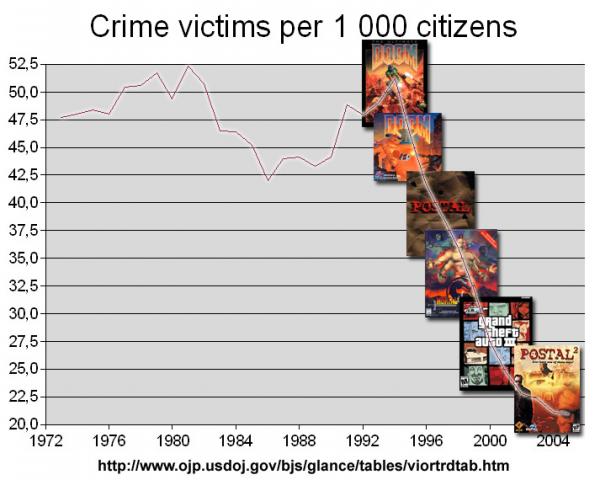
http://www.ojp.usdoj.gov/bjs/glance/tables/viortrdtab.htm
Further game based research and references
Books
Book Chapters
- Klopfer, E. 2006. Handheld Simulation Games for Learning, In Press for E. Soloway. Untitled
- Squire, K.D. (2005). Game-based learning: The present and future of state of the field. Report to the Masie Consortium.
- Klopfer, E. & Squire, K., Jenkins, H. (2004). Environmental Detectives: PDAs as a Window into a Virtual Simulated World. Kerres, M., Kalz, M., Stratmann, J., de Witt, C. Eds., Didaktik der notebook-universität, (pp.259-274). Münster:Waxmann Verlag.
- Jenkins, H. Squire, K. & Tan, P. (2003). You Can’t Bring That Game To School!: Designing Supercharged! In B. Laurel (Ed.) Design research. (pp. 244-252). Cambridge, MIT Press.
- Holland, W., Jenkins, H. & Squire, K. Theory by Design (2003). In Perron, B., and Wolf, M. (Eds). Video game theory reader. (pp. 25-46). London: Routledge.
- “Interactive Audiences?: The 'Collective Intelligence' of Media Fans” in Dan Harries (ed.), The New Media Book, (London: British Film Institute, 2002)
- Jenkins, H. and Squire, K. (2002) Art of contested spaces. In King, L. (Ed.), Game on: The history and culture of video games (pp. 64-75). New York: Universe Publishing.
Journal Articles
- Squire, K.D. (2002). Rethinking the role of games in Education. Game Studies, 2(1)
-
Squire, K., & Durga, S. (in press). Productive gaming: The case for historiographic game play. To appear in R. Ferdig (Ed.) The handbook of educational gaming. Hershey, PA: Information Science Reference.
Squire, K.D., DeVane, B. & Durga, S. (in press). Designing centers of expertise for academic learning through video games. To appear in Theory Into Practice.
Squire, K. (2007). Games, learning, and society: Building a field. Educational Technology, 4(5), 51-54.
Squire, K., & Durga, S. (in press). Productive gaming: The case for historiographic game play. To appear in R. Ferdig (Ed.) The handbook of educational gaming. Hershey, PA: Information Science Reference.
Squire, K. (2008). Open-ended video games: A model for developing learning for the interactive age. In K. Salen (Ed.) The John D. and Catherine T. MacArthur Foundation series on digital media and learning. (167-198) Cambridge, MA: The MIT Press.
Squire, K.D. (2006). From content to context: Video games as designed experiences. Educational Researcher, 35(8), 19-29.
Squire, K.D. Giovanetto, L., DeVane, B. & Durga, S. (2005). From users to designers: Building a self-organizing game-based learning environment. Technology Trends 49(5), 34-42.
Squire, K.D. (2005). Changing the game: What happens when videogames enter the classroom?. Innovate 1(6).
Shaffer, D. W., Squire, K.D., Halverson, R., & Gee, J.P. (2005). Video games and the future of learning. Phi Delta Kappan, 87(2), 105-111.
Squire, K.D. (2005). Toward a theory of games literacy. Telemedium 52 (1-2), 9-15.
Squire, K. & Jenkins, H. (2004). Harnessing the power of games in education. Insight (3)1, 5-33.
Squire, K.D. (2002). Rethinking the role of games in education. Game Studies, 2(1). Last retrieved August 31 2005 from http://gamestudies.org/0201/Squire/.
Squire, K. (2003). Video games in education. International Journal of Intelligent Simulations and Gaming (2) 1.
- Games-to-Teach Team. (2003). Design principles of next-generation digital gaming for education. Educational Technology, 43(5), 17-33.
- Jenkins, H., Klopfer, E., Squire, K. & Tan, P. (2003). Entering the education arcade. Computers in Entertainment 1(1), 17-17.
- Squire, K.D., Makinster, J., Barnett, M., Barab, A.L., & Barab, S.A. (2003). Designed Curriculum and Local Culture: Acknowledging the Primacy of Classroom Culture. Science Education. 87,1– 22.
- Squire, K. (2003). Video games in education. International Journal of Intelligent Simulations and Gaming (2) 1.
- Klopfer, E. S. Yoon, and L. Rivas. 2004 Comparative Analysis of Palm and Wearable Computers for Participatory Simulations. Journal of Computer Assisted Learning 20, 347-359.
- Jenkins, H. & Squire, K (2004). Harnessing the power of games in education. Insight (3)1, 5-33.
- Squire, K.D. (2004). Sid Meier’s Civilization III. Simulations and Gaming, 35(1): 135-140.
- Squire, K.D. (2005). Recessitating educational technology research: design based research as a new research paradigm. Educational Technology 45(1), 8-14.
- Squire, K.D. (2005). Changing the Game: What Happens When Video Games Enter the Classroom?. Innovate 1(6).
- Squire, K.D. & Steinkuhler, C.A. (2005). Meet the gamers: Games as sites for new information literacies. Library Journal.
- Klopfer, E. and S. Yoon. 2005. Developing Games and Simulations for Today and Tomorrow's Tech Savvy Youth. Tech Trends. 49(3) 33-41.
- Klopfer, E. and K. Squire. 2005. Environmental Detectives – The Development of an Augmented Reality Platform for Environmental Simulations. In Press for Educational Technology Research and Development.
- Klopfer, E. and K. Squire. Case Study Analysis of Augmented Reality Simulations on Handheld Computers. In Press for The Journal of the Learning Sciences.
- Rosenbaum, E., Klopfer, E., and Perry, J. (2006). On Location Learning: Authentic Applied Science with Networked Augmented Realities. In Press for Journal of Science Education and Technology.
- Klopfer, E. (2006). Blurring Lines with Mobile Learning Games. In Press for Educational Technology Magazine
- Squire, K.D. (in press). From content to context: Videogames as designed experiences. To appear in Educational Researcher.
- Squire, K., D. & Klopfer, E. (in press). Augmented Reality Games on Handheld Computers, Journal of the Learning Sciences.
- Klopfer, E. & Squire, K. (in press). Developing a platform for augmented reality gaming. To appear in Educational Technology Research & Development.
- Squire, K.D. & Jan, M. (in press). Mad City Mystery: Developing scientific argumentation skills with a place-based augmented reality game on handheld computers. To appear in Journal of Science Education and Technology.
- Squire, K.D. (in press). Game-Based Learning: An emerging paradigm of instruction. To appear in Performance Improvement Quarterly. ;
-
Squire, K.D. & Johnson, C.B. (2003). Using interactive television to enhance authenticity in K-12 REALs: Two case studies. International Journal of Continuing Engineering Education and Lifelong Learning, 13(5-6), pp. 454-470.
-
Squire, K.D., Makinster, J., Barnett, M., Barab, A.L., & Barab, S.A. (2003). Designed Curriculum and Local Culture: Acknowledging the Primacy of Classroom Culture. Science Education. 87:1– 22.
-
Barab, S. A., Barnett, M., & Squire, K. (2002). Preparing pre-service teachers: Developing an empirical account of a community of practice. The Journal of the Learning Sciences 11(4), 489-542.
-
Barab, S., A., Barnett, M., Yamagata-Lynch, L., Squire, K., & Keating, T. (2002). Using activity theory to understand the contradictions characterizing a technology-rich introductory astronomy course. Mind, Culture, and Activity, 9(2), 76–107.
-
Barab, S. A., Hay, K. E., Barnett, M. G., & Squire, K. (2001). Constructing Virtual Worlds: Tracing the Historical Development of Learner Practices/Understandings. Cognition and Instruction.19(1), 47-94.
-
Squire, K.D. & Johnson, C.B. (2000). Supporting Distributed Communities of Practice with Interactive Television. Educational Technology Research & Development, (48),1, p. 23-44.
-
Squire, K. D. & Reigeluth, C. M. (2000). The Many Faces of Systemic Change. Educational Horizons, 78(3), p. 143-152.
-
Barab, S. A., Squire, K., & Dueber, B. (2000). Supporting authenticity through participatory learning. Educational Technology Research and Development, 48(2), p. 37-62.
-
Barab, S. A., Hay, K. E., Squire, K., Barnett, M., Schmidt, R., Karrigan, K., Yamagata-Lynch, L., & Johnson, C. (2000). Virtual solar system project: Learning through a technology-rich, inquiry-based, participatory learning environment. Journal of Science Education and Technology, 9(1), 7-25.
-
Squire, K. D. (1999). Opportunity Initiated Systems Design. Systems Practice and Action Research. 12(6), p. 633-648.
-
Reigeluth, C. M. & Squire, K. D. (1998) Emerging Work in the New Paradigm of Instructional Theory. Educational Technology, July.
Commentaries and Reviews
- “The Most Fun You Can Have with Model Railroads..., September 24, 2000
- “Sheep: Fast Paced Old School Action Game, January 2001
- “Sid Meier's Pirates, November 2, 2000
- “Shenmue: February 6, 2001
- “Alice: American MgGee's Ambitious Undertaking, January 18, 2001
- “Lego Team Alpha January 4, 2001
- “Civilization III. October 31, 2001
- “Book Review: Utopian Entrepneur,” November 7, 2001
- “Book Review: Digital Game-Based Learning,” n.d.
- “Book Review: Steven Kent,” n.d.
- “Book Review: Trigger Happy,” n.d.
- “Book Review: Revolutionaries at Sony.” December 23, 2000
- “A Gamer's Guide to a Parent's Guide to Video Games,” December, 1999
Game Culture
-
Squire, K. & Giovanetto, L. (in press). The higher education of gaming. To appear in elearning.
-
DeVane, B. & Squire, K. (in press). The Meaning of Race and Violence in Grand Theft Auto: San Andreas. To appear in Games & Culture.
-
Squire, K. (in press). Video games literacy: A literacy of expertise. To appear in J. Coiro, M. Knobel, D. Leu, & C. Lankshear, Handbook of research on new media literacies. New York: MacMillan.
-
Jenkins, H. & Squire. K. (2007). Applied game theory: Innovation, diversity, experimentation in contemporary game design. In A. Jahn-Sudmann (Ed). Games without frontiers.
-
Squire, K. (in press). Critical education in an interactive age. To appear in Diana Silberman Keller, (Ed). Mirror Reflections: Popular culture and education. NY: Peter Lang Publishers
-
Squire, K. D. & Steinkuehler, C. A. (2006). Generating CyberCulture/s: The case of Star Wars Galaxies. In D. Gibbs & K. L. Krause (Eds.), Cyberlines 2.0 Languages and cultures of the Internet (177-198). Albert Park, Australia: James Nicholas Publishers.
-
Squire, K.D. (in press). Civilization III as a world history sandbox. To appear in Civilization and its discontents. Virtual history. Real fantasies. Milan, Italy. Ludilogica Press. Now in Italian!
-
-
Squire, K. & Steinkuehler, C.A. (2005). Meet the gamers. Library Journal.
Squire, K.D. (2005). Educating the fighter. On the Horizon 13(2), 75-88.
Jenkins, H. & Squire, K.D. (2002). The Art of Contested Spaces. In L. King, (Ed.) Game On!. London: Barbican Press.
Designing Games within Education
-
Squire, K.D. (in press). Game-based learning: An emerging paradigm for learning. To appear in Performance Improvement Quarterly.
-
Squire, K. (in press). From information to experience: Place-based augmented reality games as a model for learning in a globally networked society. To appear in Teacher’s College Record.
-
Squire K.D. & Jan, M. (2007). Mad City Mystery: Developing scientific argumentation skills with a place-based augmented reality game on handheld computers. Journal of Science Education and Technology, 16(1) 5-29.
-
Squire, K., & Klopfer, E. (2007). Augmented reality simulations on handheld computers. Journal of the Learning Sciences, 16(3), 371 - 413.
Squire, K. (in press). Video Games and education: Designing learning systems for an interactive age. To appear in Educational Technology
-
Squire, K. (in press). Artists in the medium. To appear in R. Ferdig (Ed.) The handbook of educational gaming. Hershey, PA: Information Science Reference.
-
Squire, K.D., Jan, M., Matthews, J., Wagler, M., Martin, J., Devane, B. & Holden, C. (2007). Wherever you go, there you are: The design of local games for learning. In B. Sheldon & D. Wiley (Eds). The design and use of simulation computer games in education, (265-296). Rotterdam, Netherlands: Sense Publishing.
-
Klopfer, E. & Squire, K. (in press). Developing a platform for augmented reality gaming. To appear in Educational Technology Research & Development.
-
Squire, K.D. (2005). Resuscitating research in educational technology: Using game-based learning research as a lens for looking at design-based research. Educational Technology 45(1), 8-14.
-
Shaffer, D. W., & Squire, K. D. (2006). The Pasteurization of education. In Education and Technology: Issues in Policy, Administration and Application. London: Elsevier.
-
Barab, S.A. & Squire, K.D. (2004). Design-based research: Putting a stake in the ground. Journal of the Learning Sciences.
Jenkins, H. Squire, K. & Tan, P. (2004). You can’t bring that game to school!: Designing Supercharged! In B. Laurel (Ed.) Design Research. Cambridge, MIT Press.
-
Klopfer, E. & Squire, K., Jenkins, H. (2004). Environmental Detectives: PDAs as a window into a virtual simulated world. In Kerres, M., Kalz, M., Stratmann, J., de Witt, C. Eds,Didaktik der Notebook-Universität, (pp.259-274). Münster:Waxmann Verlag.
-
Jenkins, H., Klopfer, E., Squire, K. & Tan, P. (2003). Entering the education arcade. Computers in Entertainment 1(1).
-
Holland, W., Jenkins, H. & Squire, K. (2003). Theory by design. In Perron, B., and Wolf, M. (Eds). Video Game Theory. Routledge.
-
Games-to-Teach Team. (2003). Design principles of next-generation digital gaming for education. Educational Technology, 43(5), 17-33.
Virtual Worlds
- Bronack, S., Sanders, R., Cheney, A., Riedl R., Tashner, J., Matzen, N. (2008). Presence Pedagogy: Teaching and Learning in a 3D Virtual Immersive World. International Journal of Teaching and Learning in Higher Education.
Supporting Research
|
|
Tip: To turn text into a link, highlight the text, then click on a page or file from the list above.
|
|
|
|
|


Comments (0)
You don't have permission to comment on this page.